
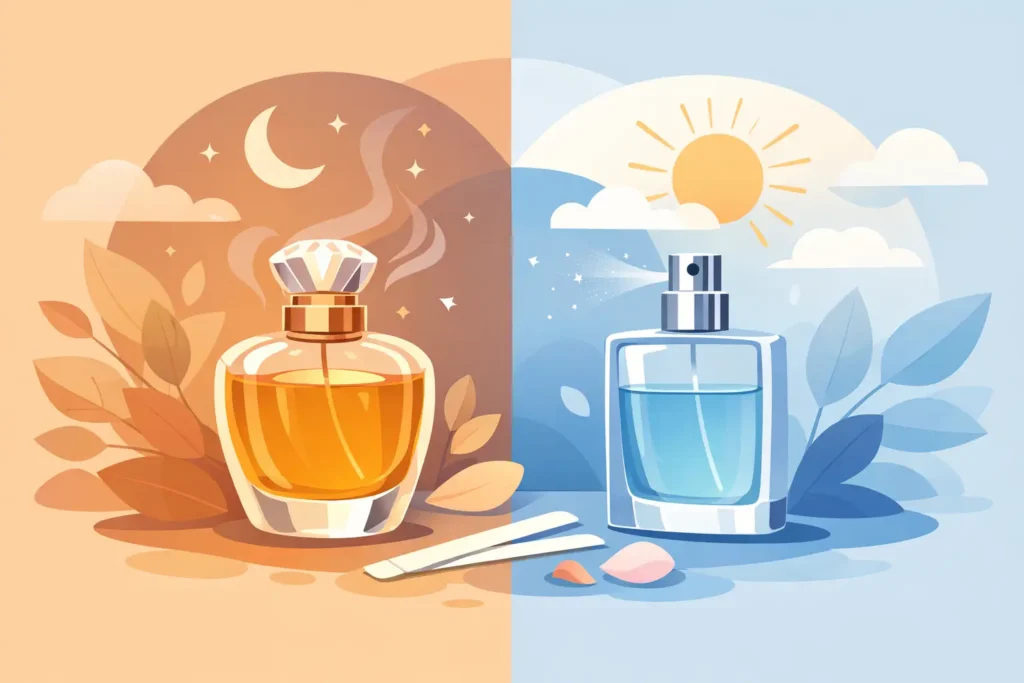
A fragrance can change the way you enter a room, remember an evening, or recognize yourself in the mirror. Yet one small phrase on the bottle can shape that experience more than many shoppers realize: eau de parfum vs toilette. The difference is not simply which one is “better.” It is about how you want your scent to wear, how long you want it to stay close, and the kind of impression you want to leave behind.
Eau de Parfum vs Toilette: The Essential Difference
Eau de parfum, often labeled EDP, generally contains a higher concentration of fragrance oil than eau de toilette, or EDT. That higher concentration usually gives an eau de parfum a richer presence and longer wear time. Eau de toilette is typically lighter, fresher, and designed to feel more effortless from the first spray.
As a general guide, eau de toilette often contains roughly 5% to 15% fragrance oil, while eau de parfum commonly falls around 15% to 20%. These ranges are useful, but they are not a universal rule. Every fragrance house has its own formula, and a bright, citrus-forward EDP may wear more softly than a dense woody EDT.
The concentration affects the way a fragrance unfolds on skin. An EDT often brings its sparkling top notes forward quickly: bergamot, grapefruit, green leaves, ocean air, and clean aromatic herbs. An EDP may reveal more depth over time, allowing florals, amber, vanilla, woods, musk, or spice to linger with a warmer, more sensual character.
Neither format is automatically more luxurious. A well-chosen eau de toilette can feel polished, memorable, and completely distinctive. The right choice depends on your skin, your setting, and the scent story you want to tell.
How Long Do EDP and EDT Last?
Most eau de toilettes last about three to six hours, while many eau de parfums remain noticeable for six to eight hours or longer. But fragrance performance is personal. Skin chemistry, humidity, temperature, application technique, and even the notes in the composition can shift those numbers dramatically.
A citrus, tea, or aquatic fragrance naturally tends to be more fleeting than one built around patchouli, resin, leather, oud, or vanilla. That is true even when both are labeled eau de parfum. Likewise, a classic EDT with strong woods and musks may stay with you well into the evening.
Projection matters too. This is the scent trail that reaches beyond your skin. Eau de parfum often has more body and a longer dry-down, but it does not always project farther than eau de toilette. Some EDPs are intimate, designed to be discovered up close. Some EDTs open with a vivid, airy brightness that makes an immediate impression.
For the most reliable wear, apply fragrance to clean, moisturized skin. Focus on pulse points such as the wrists, neck, and inner elbows, then let the scent settle naturally. Rubbing your wrists together can disturb the opening notes, especially in a delicate EDT. If you want more longevity, a light mist on clothing can help, though it is wise to test an inconspicuous area first.
When Eau de Toilette Makes the Better Choice
Eau de toilette is often the perfect match for daytime, warm weather, work, travel, and anyone who likes to refresh their fragrance during the day. Its lighter structure can feel crisp rather than overwhelming, especially in close settings such as an office, classroom, or airplane.
Think of EDT as a confident finishing touch. A fresh aromatic scent before a morning meeting, a clean floral for lunch outdoors, or a bright designer fragrance for a casual dinner can all feel right in this format. It gives you presence without asking the room to pause for you.
It can also be a smart choice if you enjoy variety. Since an EDT may fade sooner, you have the freedom to change your fragrance between day and night. A revitalizing citrus or aquatic scent in the morning can make way for something deeper after dark.
That said, lighter does not mean weak. Many beloved designer eau de toilettes have unmistakable character. Their appeal is often in the contrast: a fresh opening, a smooth heart, and a subtle trail that feels natural rather than heavily perfumed.
Choose EDT when you want freshness and flexibility
An eau de toilette is especially appealing if you prefer clean, airy scents; live in a hot or humid climate; work around people who may be sensitive to fragrance; or like reapplying a scent as part of your routine. It also makes an easy gift for someone whose fragrance preferences are still taking shape.
When Eau de Parfum Is Worth It
Eau de parfum tends to shine when you want a fragrance to feel more enveloping. Its fuller concentration often amplifies the heart and base notes, creating a scent that develops beautifully over several hours. A floral EDP may become creamier and more velvety, while an amber or wood-based EDP can take on a warm, magnetic quality.
This makes EDP a natural choice for evenings, celebrations, date nights, cool weather, and moments when you want your personal aromatic signature to feel more pronounced. One or two considered sprays can be enough to carry you from the first toast to the last goodbye.
The trade-off is that more is not always better. A powerful eau de parfum can become too intense in heat or tight quarters if applied heavily. Start lightly, particularly with rich notes such as oud, tuberose, incense, leather, or sweet gourmand accords. Give the fragrance 15 to 20 minutes before deciding whether you need another spray.
Choose EDP when you want depth and staying power
Reach for eau de parfum when you want fewer touch-ups, enjoy a fragrance that evolves throughout the day, or are dressing for a cooler evening and a more memorable occasion. It is also an excellent format for fragrance lovers drawn to sensual florals, warm spices, creamy vanilla, smoky woods, and lingering musks.
Why the Same Fragrance Can Smell Different in Each Format
It is tempting to assume that an eau de parfum is simply a stronger version of the eau de toilette with the same name. Sometimes the two are very close. Often, however, they are distinct interpretations.
A fragrance house may adjust the formula to suit each concentration. The EDT might emphasize fresh citrus or aromatic notes, while the EDP brings forward rose, jasmine, amber, sandalwood, or tonka bean. The result can feel like two outfits cut from the same fabric: related, recognizable, but designed for different moments.
This is why reading a note list helps, but trying a fragrance when possible is even better. If you are shopping online, consider the scent family first. Fresh citrus, aquatic, and green scents often suit those who want a lighter feel. Floral, amber, woody, and gourmand profiles commonly offer more depth, though there are always exceptions.
Do not judge a fragrance only by its first minute. The opening is the introduction, not the full conversation. Give it time to reach the dry-down, where the notes that linger closest to your skin reveal the true character of the scent.
Is Eau de Parfum Better Value Than Eau de Toilette?
An eau de parfum often costs more per bottle because it uses a higher concentration of fragrance materials. But value is not just about the price on the label. If one or two sprays of an EDP last through your evening, it may be more economical per wear than an EDT you reapply several times.
On the other hand, an EDT can be the better value if it suits your lifestyle and you love its brighter composition. There is little benefit in paying for all-day intensity when you prefer a clean scent that fades gracefully by late afternoon.
Authenticity should remain part of the value equation. A genuine designer fragrance delivers the formula, performance, and presentation the house intended. At Luxury Scents Co., authentic designer scents and meaningful savings make it easier to choose the format that feels like you, without the department-store markup.
How to Decide Between Eau de Parfum and Toilette
Start with the moment, not the concentration. For a light daytime scent, summer heat, or an easygoing office presence, eau de toilette may be your best match. For cooler nights, special plans, or a scent you want to linger on a scarf or jacket, eau de parfum often has the advantage.
Then consider how you like fragrance to behave. Do you want a fresh lift that you can reapply without thought? Or do you want a deeper composition that stays close long after the first spray? Your answer matters more than any rule about which format is supposed to be superior.
A beautiful fragrance should feel like recognition. Whether you choose the sparkling ease of an EDT or the lasting warmth of an EDP, wear the version that makes you feel most like yourself – and let that scent become part of the memory people carry with them.