
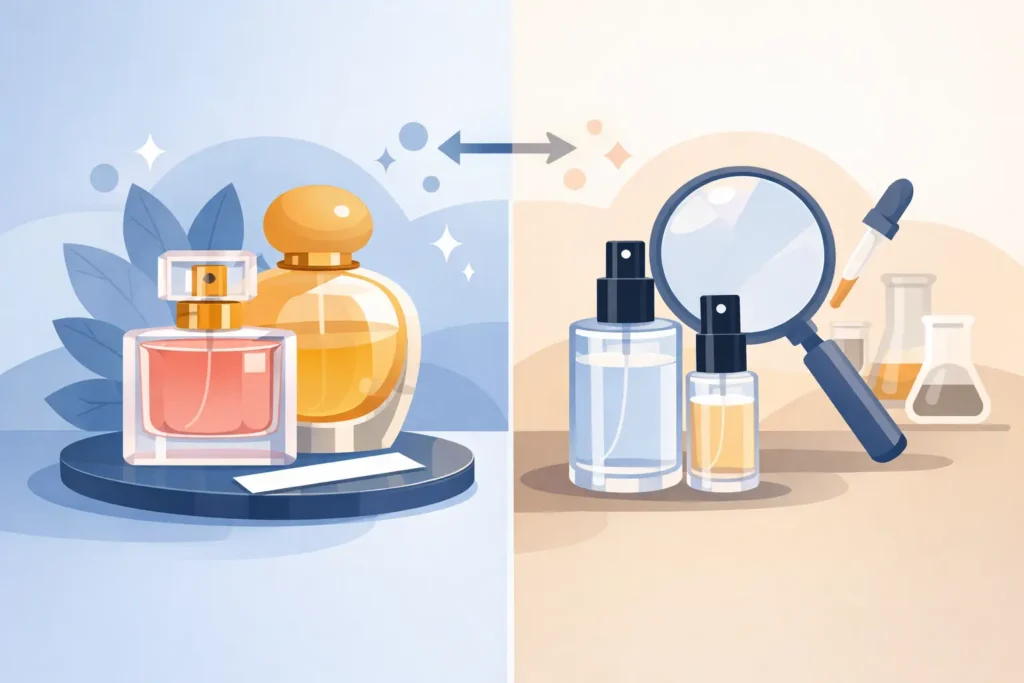
A bottle marked “tester” can look less polished than the fragrance displayed beneath glass at a department store, yet the scent inside may be the very one you know and love. Understanding perfume tester differences helps you decide whether the savings are worth giving up the presentation – and protects you from confusing a legitimate tester with an unclear or questionable listing.
For personal wear, a genuine perfume tester can be an intelligent way to make a designer scent part of your everyday signature. For a gift or a special unboxing moment, a standard retail bottle is usually the better choice. The difference is not about luxury versus lesser quality. It is primarily about how the bottle was intended to be used before it reached a shopper.
What Is a Perfume Tester?
A perfume tester is a full-size fragrance bottle supplied by a brand for in-store demonstration. It allows customers to experience a fragrance on skin before deciding whether it belongs in their collection. You may see testers for everything from a fresh eau de toilette to an intense spray with a richer, more lingering trail.
Because a tester is made to sit at a fragrance counter, its packaging is often simpler than retail packaging. It may arrive in a plain white or brown box, sometimes labeled “tester,” “demonstration,” or “not for sale.” Some testers come without a cap, while others include the same cap as the retail version.
The key point is this: an authentic tester is not a watered-down fragrance, a miniature sample, or a used bottle. It is usually a standard-size bottle created by the same fragrance house, filled with the same composition as its retail counterpart.
Perfume Tester Differences That Matter Most
Not every detail carries equal weight. The most meaningful differences involve packaging, presentation, and the condition of the bottle – not the character of the fragrance itself.
The fragrance inside
In the vast majority of legitimate cases, the juice is the same. A tester of a beloved designer fragrance should deliver the same opening notes, heart, dry-down, and concentration stated on the bottle. If you are purchasing an eau de parfum tester, it should perform as that eau de parfum is designed to perform.
There is a persistent rumor that testers are stronger than retail bottles because they are meant to persuade customers in stores. While an individual spray can smell more vivid for many reasons – fresh exposure to air, skin temperature, humidity, or simply a newly reset nose – testers are not generally formulated to be more potent. Fragrance batches can have subtle variation over time, but that is not a tester-specific advantage.
The box and outer presentation
Retail bottles are designed to feel like an occasion. They often arrive in branded boxes with polished graphics, protective inserts, and details that make the first reveal feel special. A tester box is practical rather than ceremonial. It may be plain, unsealed, or missing the decorative finish associated with a retail package.
That difference can be easy to overlook when you are buying for yourself. If the scent matters more than the carton, a tester may offer excellent value. But for birthdays, anniversaries, holidays, or a first luxury fragrance, the branded retail presentation contributes to the experience. A beautiful box is part of the gift.
The cap
A missing cap is one of the most common perfume tester differences. Counter testers need to be easy for many customers to spray, so brands may ship them without a cap or with a basic placeholder cap. This does not automatically affect authenticity or scent quality.
Still, a cap serves a practical purpose. It helps protect the atomizer from dust and makes a bottle feel more complete on a vanity or shelf. If you enjoy displaying your fragrance collection, confirm whether a tester includes its original cap before purchasing. Listings should be clear about this detail rather than leaving you to guess.
Bottle markings and condition
A genuine tester may have “tester” or “demonstration” printed on the bottle or its box. It should still have a functioning sprayer, a clean appearance, and a fill level consistent with a new product. Tester bottles are not supposed to be heavily used.
Because they may have been handled during distribution, minor cosmetic variation can happen. A tiny scuff on a plain tester box is not the same thing as a damaged bottle, a weak atomizer, or an unusually low fill level. Those are separate concerns and deserve direct answers from the seller.
Why Testers Can Cost Less
A tester typically costs less because the brand has not included the full retail presentation. The savings come from simpler packaging and, in some cases, the absence of a decorative cap. You are paying for the fragrance rather than every component of the shelf-ready experience.
That can make a tester especially appealing if you have already worn the scent and know it suits you. Perhaps a warm amber fragrance has become your evening calling card, or a bright citrus cologne is the clean confidence you reach for every morning. If you will use the bottle rather than wrap it, a tester can be a sensible route to a recognizable designer fragrance at a lower price.
The trade-off is straightforward: lower cost may mean a plain box, no cap, or less gift-worthy presentation. It should not mean uncertainty about what you are buying.
How to Shop Testers With Confidence
The word “tester” should never be used to excuse vague product information. Authentic fragrance shopping still comes down to the seller’s standards, product details, and willingness to stand behind an order.
Before you buy, look for a listing that clearly identifies the fragrance name, concentration, bottle size, and tester condition. It should say whether a cap and retail box are included. Be cautious with descriptions that use unclear phrases such as “tester style,” “inspired by,” or “similar to.” Those terms do not promise an authentic brand-produced tester.
Pay attention to price, but do not make price your only test. Exceptional discounts can be appealing, especially when you want to expand your fragrance wardrobe, but a price that appears impossible deserves a closer look. Trust is built through transparent descriptions, secure payment, responsive support, and a return policy that gives you a clear path if an unused item is not what was represented.
For fragrance lovers who value authenticity as much as value, the best sellers make the distinction easy to understand. You should know whether you are selecting a retail bottle with full presentation or a tester bottle focused on the scent itself.
Tester vs. Retail Bottle: Which Should You Choose?
Choose a tester when the fragrance is for you, the scent is already familiar, and presentation is not a priority. It is a particularly practical option for a signature scent you plan to wear often. The bottle may be simpler, but the confidence of wearing a fragrance that feels unmistakably yours remains the point.
Choose a retail bottle when you are gifting, collecting, displaying, or trying a fragrance house for the first time. The branded box, original cap, and sealed presentation create a more complete luxury moment. A retail bottle also removes any concern about whether the product will arrive in the exact format you pictured.
There is no universally better option. A tester is about smart value and scent-first shopping. A retail bottle is about the full ritual – the box in your hands, the cap’s weight, and the anticipation before the first spray.
A Few Misconceptions to Leave Behind
A tester is not automatically old. Like retail inventory, its age depends on production and storage, not on the word printed on the packaging. It is also not automatically opened and used by shoppers. Legitimate testers sold through retail channels should be new products, even if their original purpose was in-store display.
Likewise, a retail bottle is not inherently more authentic simply because it has a glossy box and cellophane. Counterfeiters can imitate packaging, which is why the reputation and transparency of the retailer matter as much as the appearance of the carton.
The most useful question is not, “Is a tester better?” Ask instead, “What experience do I want from this purchase?” If you want the fragrance itself at the strongest possible value, a genuine tester can make perfect sense. If you want every detail of the luxury ritual, choose the retail bottle and enjoy the moment from the first unwrapping to the final lingering note.